AI DIGITAL PRODUCT LAB · LESSON 01 OF 16 · FREE TO READ
One buyer, one job, one file
One product idea you have personally done twenty times, with its buyer, its job, its format and a first price.
A digital product is a file that does a job for a stranger while you sleep. That is the whole business. Not a brand, not a funnel, not a "passive income empire". A checklist that stops a maker forgetting the label shot. A spreadsheet that prices a wedding cake. A set of twelve prompts that get a florist decent product photos. A five-page planner. Small, specific, finished. Bought for the price of a lunch by someone who would rather pay than figure it out.
Here is what the internet will not tell you: most digital products sell a few copies a week, to people who found them because they were looking for exactly that. That is a good business at $19 a copy if the file is genuinely useful, because it costs nothing to deliver and you made it once. It is a terrible business if the file is a forty-page AI-written "Ultimate Guide" that says nothing, because the buyer knows in the first paragraph and asks for a refund. The difference is not marketing. It is whether the product does a job.
Sell the hour you save them, not the pages you wrote.N.V.
The menu
Checklist
One or two pages. The things you check every time, in order, that beginners skip. Fastest to make, cheapest to sell ($5 to $15), best first product.
Workbook or planner
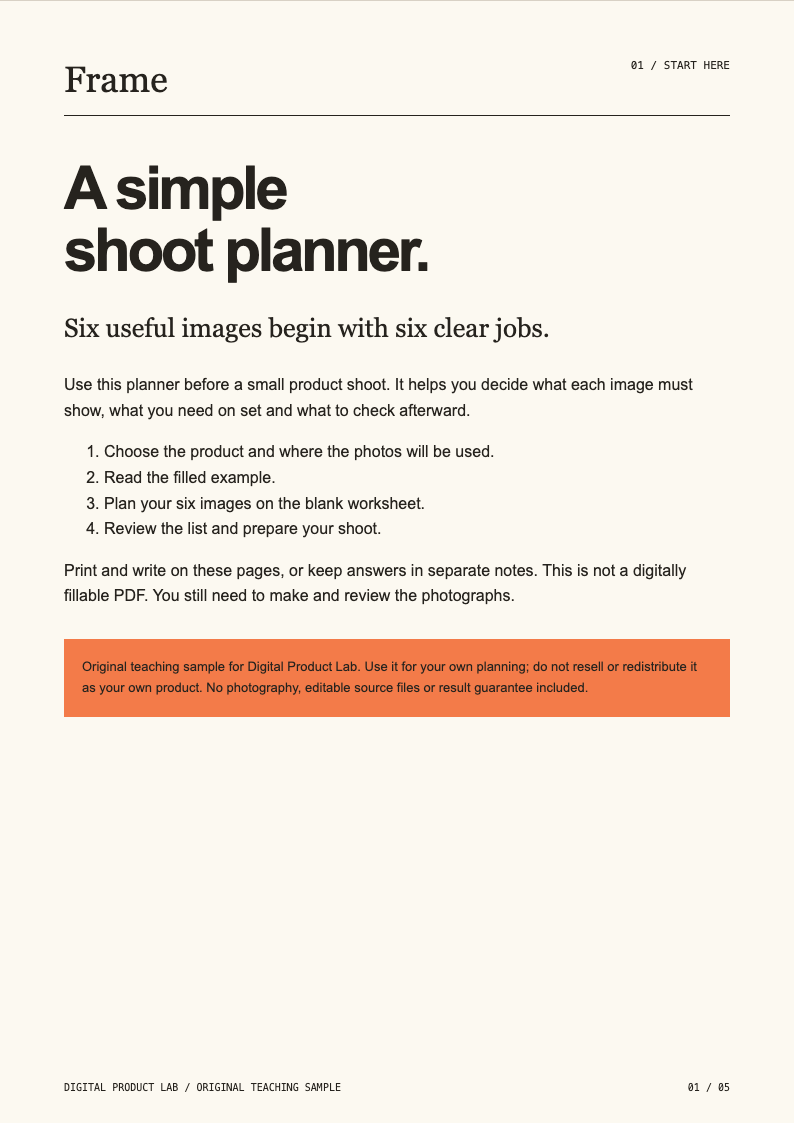
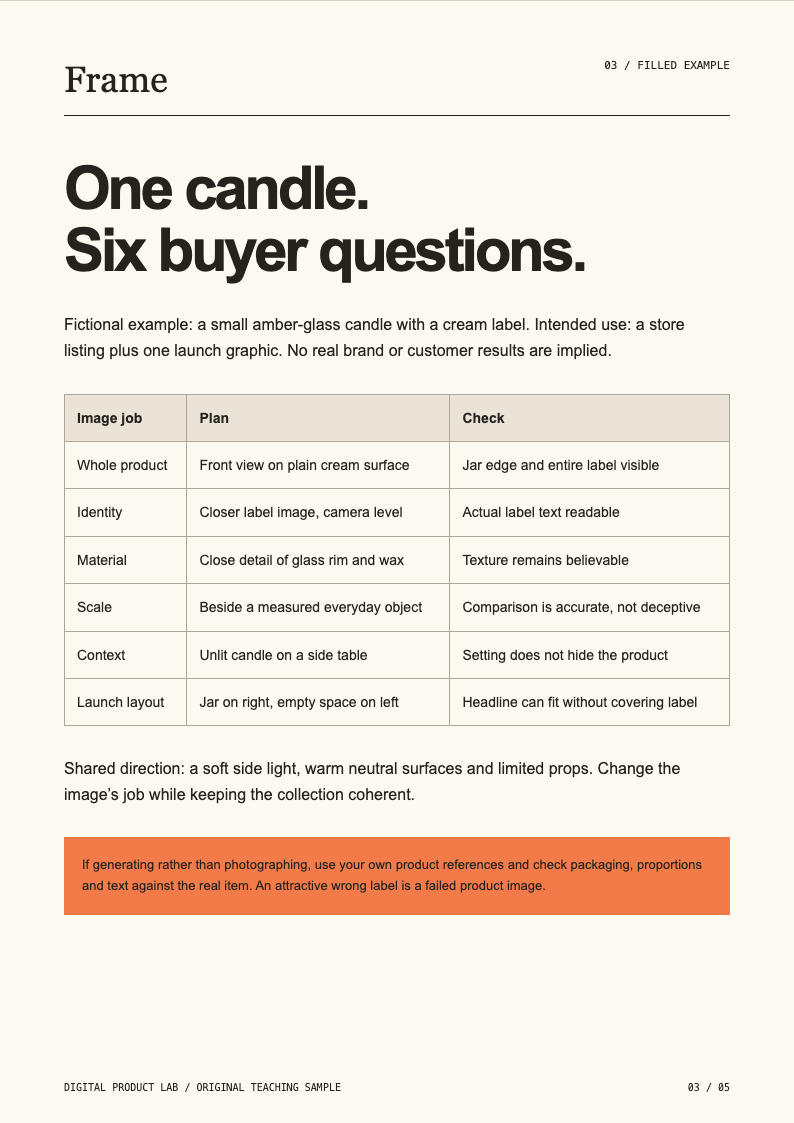
Four to twelve pages. A sequence of decisions with a filled example and blank fields. Frame, the worked example in this course, is one. $15 to $35.
Template
A Canva, Notion or Google Sheets file the buyer copies and fills. Sold as a link. The spreadsheet that does the maths for them is the strongest kind. $9 to $39.
Prompt pack
Twenty to fifty tested prompts for one specific outcome, each with the result it produced and what to change. Only worth money if every prompt has been run. $9 to $29.
Preset or asset pack
Lightroom presets, LUTs, brushes, fonts, mock-ups. Needs real craft skill; crowded; buyers compare on before/after images. $9 to $49.
Guide
Text that teaches. The most common product and the most often junk. Only make one if every page has a worked example from your own work. $19 to $49.
Three tells of a product that will not sell
- TELL 1
The buyer is "anyone"
"For creatives who want to grow" is nobody. "For a maker listing their first candle on Etsy this month" is a person with a credit card and a deadline.
- TELL 2
The job is a topic, not a task
"Everything about product photography" is a library. "Decide the six photos before the shoot" is a task with an end.
- TELL 3
You have not done it
If you cannot tell a bad result from a good one in seconds, you cannot write the check on each page, and the check is the product.
What you need, and what it costs
The stack
WHAT YOU USE
- Claude or ChatGPT to interview you, draft from your notes, edit out the fluff and play the sceptical buyer. Free tiers work; the paid tier makes the designed-document step easier.
- Canva (free, or Pro at about $15 a month for the brand kit and more fonts) to lay out the pages and export the PDF. Or Google Docs if the product is plain.
- Payhip to sell it: no monthly fee, a percentage per sale, delivery handled. Gumroad and Etsy are the alternatives, compared in Lesson 9.
- An image model for the cover and the mock-up photo: ChatGPT images or Nano Banana Pro. A few dollars.
WHAT TO EXPECT
- The course price is not your product budget. Everything above is bought from those providers, and all of it can be done for under $20 the first month.
- Time: one weekend to find and outline, one to make and test, one evening to list. Three weeks at a few hours a week.
- Money in: plan on ten sales in the first month if you have an audience and a few if you do not. The point of the first product is the second one.
- Nothing here needs a website, a domain, an email tool or ads. Those come after the first ten sales, if ever.
Find the idea by being interviewed
Do not brainstorm. Brainstorming gives you what sounds good. Being interviewed gives you what you have actually done. Paste this into Claude or ChatGPT and answer one question at a time. It ends with five ideas built from your answers, and a recommendation for the one you can finish in two weekends.
The idea interview (Claude or ChatGPT)
You are helping me find one small digital product I can make from what I already know. Interview me one question at a time. Ask, wait, then ask the next. Never suggest an answer for a fact about me. Do not flatter me.

Ask, in this order:
1. What do people already ask me for help with? List everything, even small things.
2. What task have I done more than twenty times, well enough that I can tell a bad result from a good one in seconds?
3. When I do that task, what do I always check, write down, or set up first? What do beginners skip?
4. Who is the person who struggles with this task? Describe them at the moment they struggle, not as a demographic.
5. What do they do today instead: a free guide, a YouTube video, guessing, paying someone?
6. What does the finished result of the task look like when it is done right? Something they could hold, print, send or post.
7. What have I made for myself to do this task: a checklist, a spreadsheet, a template, a set of prompts, a list of settings?
8. How long does the task take a beginner, and how long does it take me?
9. Which of my answers could I prove with an example from my own work this week?

When all nine are answered, propose exactly five product ideas. For each: a working name; the buyer in one line; the job in one line; the format (checklist, workbook, template, prompt pack, preset pack, spreadsheet); what the buyer holds at the end; how long it would take them to get that result using it; the one thing that makes it better than the free option; and a first price between $9 and $49 with one sentence of reasoning. Then say which one I could finish in two weekends and why. Do not propose anything I have not personally done. Do not propose a course about making money.
Answer with real cases. "I helped a friend price her cakes and we built a sheet" is worth more than "I am good at pricing."
The finish line
One file, a listing page where a stranger can pay and receive it, tested from a separate browser, with a real person having used the pages to finish the task. That is the course. Sales come from the product being good and from you showing it doing its job, which is the last part of the course. Nobody can promise you sales, and anyone who does is selling you a course about selling courses.